
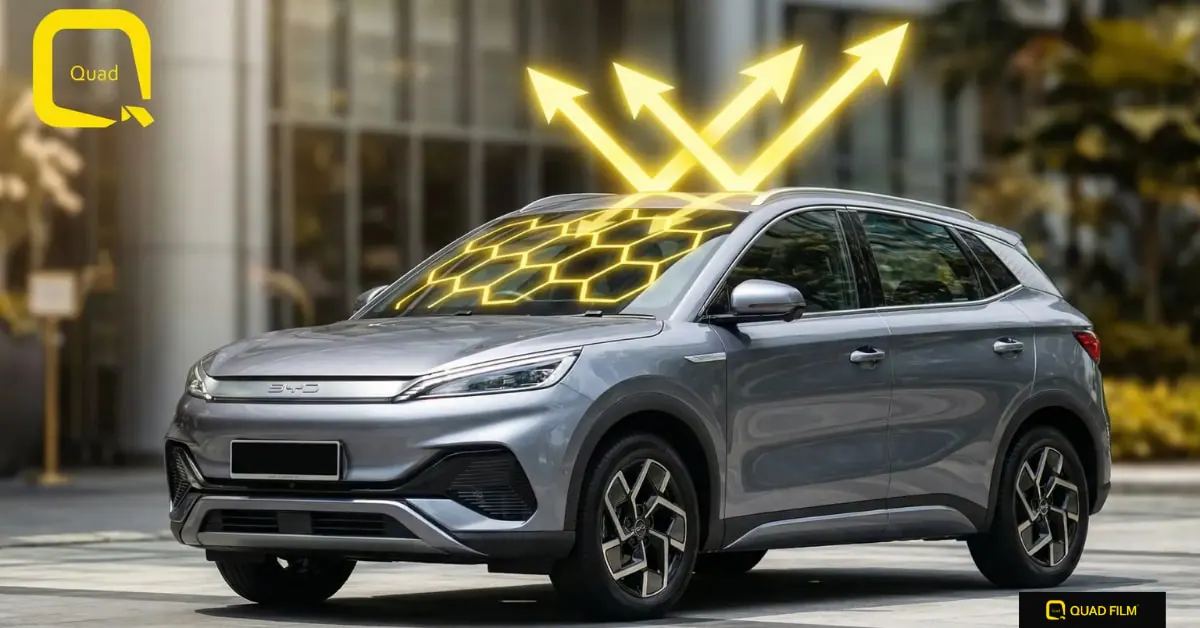
- PPF protects your EV's paint from stone chips, UV damage and road debris, which matters more on cars that cost RM150,000 to RM350,000+ and are kept for 5 to 8+ years.
- EV-specific concerns like thin factory paint (especially Tesla), sensor compatibility and range impact are all manageable with quality PPF installed by experienced shops.
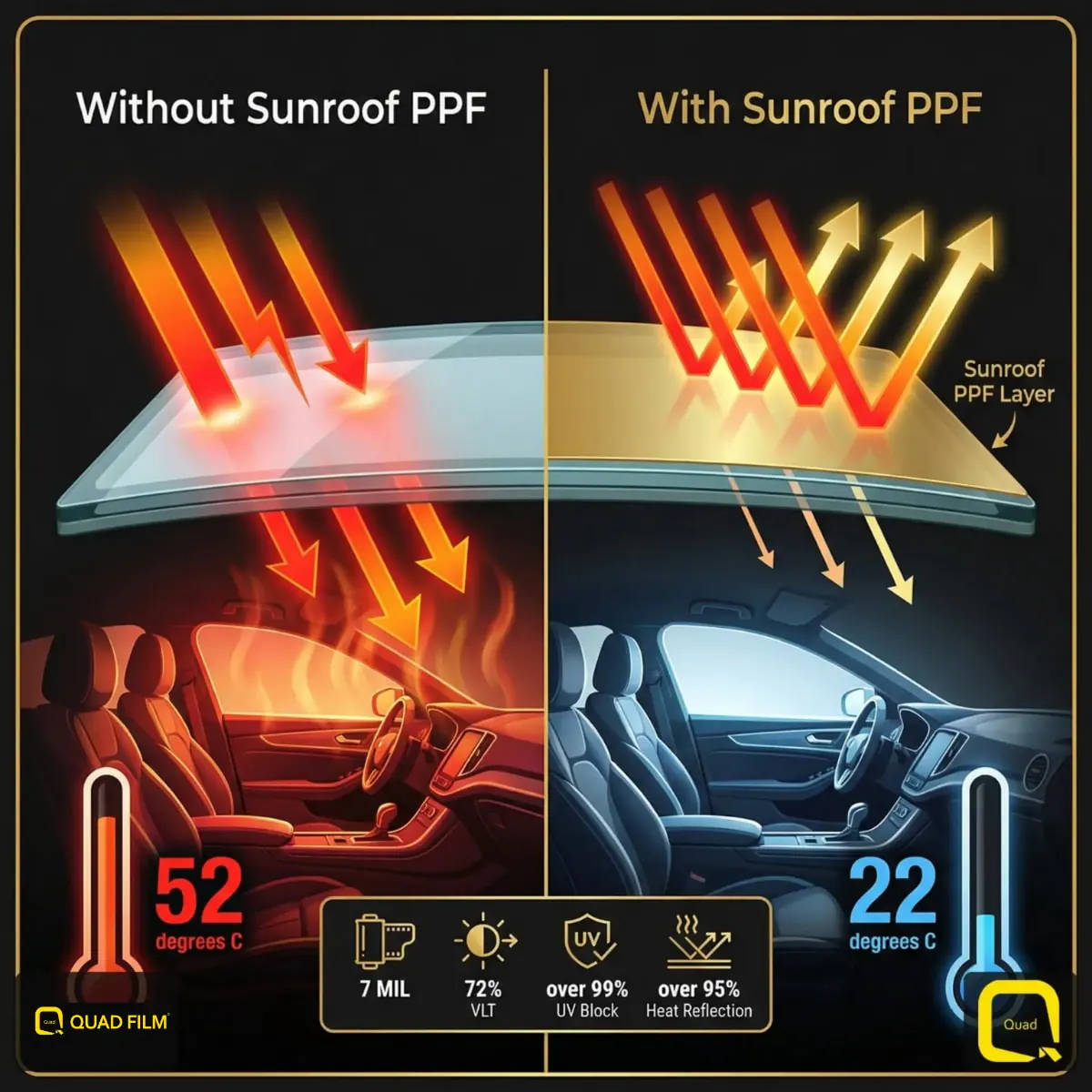
- Panoramic sunroof PPF is one of the most practical upgrades for Malaysian EV owners, reducing cabin temperature from 52 degrees to 22 degrees and cutting air conditioning load to preserve driving range.
- Full front PPF plus sunroof PPF is the recommended starting point for most EVs in Malaysia, with full body coverage ideal for higher-value models.
- Budget from RM800 for sunroof PPF to RM8,000 to RM16,000+ for full body PPF depending on film grade and vehicle size.
PPF for electric cars in Malaysia has become one of the most common requests at detailing shops across the Klang Valley. With models like the Tesla Model 3, BYD Atto 3, smart #1 and Perodua QV-E now a regular sight on Malaysian roads, EV owners are actively looking for ways to protect their investment from day one. These cars often cost RM150,000 to RM350,000 or more, and the paint takes a beating from highway gravel, tropical UV and the heat that comes with outdoor charging sessions. But EVs bring a few unique considerations that petrol car owners do not face. This article breaks down what those are, where to apply PPF on your EV, and how sunroof PPF solves the panoramic glass heat problem that almost every Malaysian EV owner deals with.
If you are new to PPF and want a full overview of how paint protection film works, start with our guide on paint protection film malaysia.
Why EV Owners in Malaysia Should Consider PPF
Higher Vehicle Cost Means Higher Stakes
EVs tend to cost more than their petrol equivalents. A Tesla Model 3 starts above RM180,000. A BYD Seal or BMW iX can push past RM300,000. When the car costs that much, leaving the paint exposed to daily highway damage is a risk that does not make financial sense. PPF acts as a physical barrier between the paint and everything the road throws at it.
Longer Ownership Periods
Many EV owners plan to keep their car for 5 to 8 years or longer. EVs have fewer mechanical wear points than petrol cars (no engine oil changes, fewer brake replacements due to regenerative braking), so the body and paint need to last the full ownership cycle. A 5 to 7 year PPF warranty aligns well with this timeline.
Resale Value Preservation
The Malaysian used EV market is still young. As it matures, cars in better cosmetic condition will sell for noticeably more. Stone chips on the front bumper or UV-faded paint on the bonnet can knock thousands off a resale price. PPF keeps the original paint underneath in factory condition.
Outdoor Charging Exposure
Many Malaysian EV owners charge at public stations at malls, office buildings and highway rest stops. The car sits under direct sun for 30 to 60 minutes or more during each session. This repeated UV exposure accelerates paint oxidation and clear coat breakdown faster than a car that goes straight into a covered parking structure after every drive.
EV-Specific PPF Considerations
Paint Types on Popular EVs
Not all factory paint is the same. Tesla uses a water-based paint system that is thinner and softer than traditional automotive paint. Stone chips show up quickly and are more visible on Tesla's flat body panels. BYD, smart and other Chinese-market EVs vary in paint thickness and quality from model to model. PPF adds a consistent 7.5 to 10 MIL protection layer regardless of how thick (or thin) the factory paint is underneath.
European EVs from BMW, Mercedes and Volvo generally have better factory paint, but Malaysian highway conditions (loose gravel, construction zones, motorcycles kicking up debris) affect every car equally.
Sensor and Camera Compatibility
Modern EVs rely on cameras, radar and ultrasonic sensors for autopilot, parking assist and blind spot monitoring. This is one of the most common concerns EV owners raise before getting PPF.
The short answer: quality clear PPF does not interfere with sensor function when installed correctly. The film is optically clear and does not block radar or ultrasonic signals. The key is to avoid applying PPF directly over camera lenses or radar housings unless the installer has specific experience with EV sensor placements. A shop that regularly works on Tesla, BYD or smart models will know exactly which areas to cover and which to leave exposed.
Weight and Range Impact
PPF adds roughly 2 to 3 kg for a full body application. To put that in perspective, that is less than a single passenger's backpack. The impact on EV range is practically zero. You will not notice any difference on your battery percentage after a 100 km drive.
The Panoramic Sunroof Problem and How Sunroof PPF Solves It
This is where the conversation shifts from general PPF to something specific to EVs.
Most popular EVs in Malaysia come with large fixed panoramic glass roofs. The Tesla Model 3 and Model Y have a full glass roof from windscreen to rear window. The BYD Seal, smart #1 and #3, and Volvo EX30 all feature panoramic glass panels. These roofs look great, but they let in a lot of heat.
Malaysian drivers know the problem well. Park your EV outdoors for 30 minutes and the cabin becomes unbearably hot. The factory UV coating on the glass helps with UV rays, but it does little against infrared heat, which is what actually makes the cabin feel like an oven.
Sunroof PPF is a specialised film designed for glass surfaces. It bonds directly to the panoramic glass and reflects infrared heat while maintaining visibility. Unlike aftermarket tint strips, pop-on shades or suction cup sun blockers, sunroof PPF provides consistent performance across the entire roof panel with no gaps.
For EV owners, this matters beyond comfort. When the cabin is hotter, the air conditioning works harder. When the A/C works harder, it draws more power from the battery. That directly reduces your driving range. In a controlled test at 33 to 35 degrees ambient temperature, a car with EV Sunroof PPF retained 63% battery after 140 km compared to 53% with a competing brand. That is a 10% power saving over a single drive.
The EV Sunroof PPF uses magnetron sputtering technology infused with 24 layers of rare earth metals including gold and silver. It provides over 95% heat reflection, blocks more than 99% of UV, maintains 72% VLT (visible light transmittance) for clear visibility, and reduces interior temperature from 52 degrees to 22 degrees in testing.
Where to Apply PPF on an Electric Car
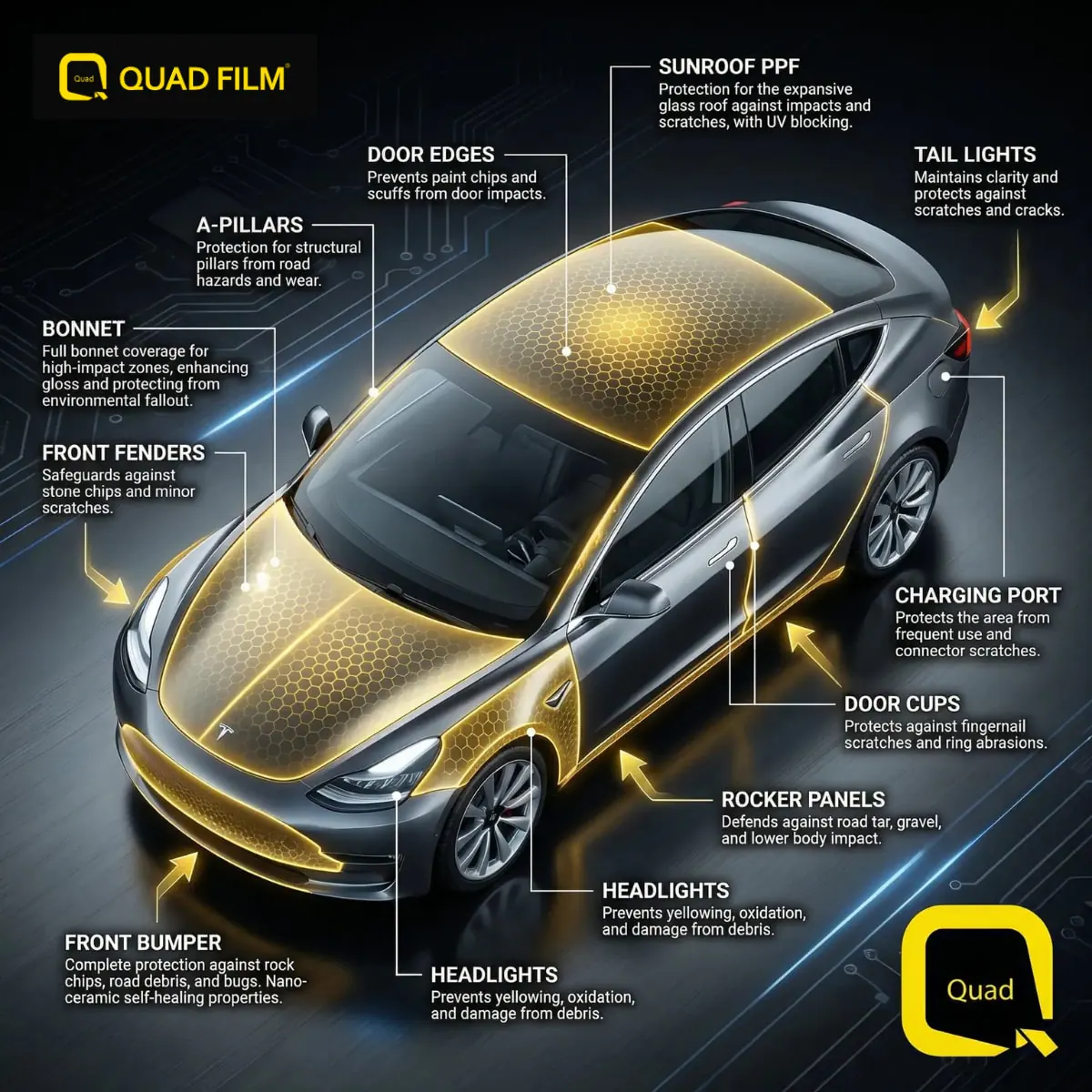
Here is a practical breakdown of where PPF adds the most value on an EV:
- Front bumper and bonnet -- the two highest-impact zones on any car. Highway gravel, road debris and insect damage hit the front end first.
- Front fenders and A-pillars -- EVs with smooth, flush body lines (especially Tesla) show chips and dings more visibly than cars with sharper body creases.
- Door edges and door cups -- protects against parking lot scratches, especially useful if you regularly park at busy mall charging stations.
- Rocker panels and side skirts -- low panels that catch road spray, small stones and debris from the tyres of the car in front.
- Panoramic roof -- sunroof PPF for heat and UV rejection (covered in the section above).
- Headlights and tail lights -- prevents yellowing and stone chip damage over time.
- Charging port area -- a small but practical addition. Prevents scuffs from repeated charger cable contact.
PPF Cost Considerations for EVs
EV body panels can be slightly more complex to work with. Flush door handles, sensor housings, curved front fascias and large single-piece bonnets can increase installation time. This may add a small premium compared to a standard sedan.
For reference, full body PPF on a sedan-sized EV starts from around RM9,000 for mid-range film (QUANTA) and goes up to RM15,000 or more for flagship-grade 10 MIL film (QUANTUM). SUV and MPV pricing scales up from there. Sunroof PPF starts from RM800 for a standard car. If you are budgeting for both body PPF and sunroof PPF together, plan your package upfront for the best value.
For a detailed breakdown of pricing by vehicle size and coverage type, see our guide on ppf price malaysia.
Popular EV Models in Malaysia and Recommended PPF Coverage
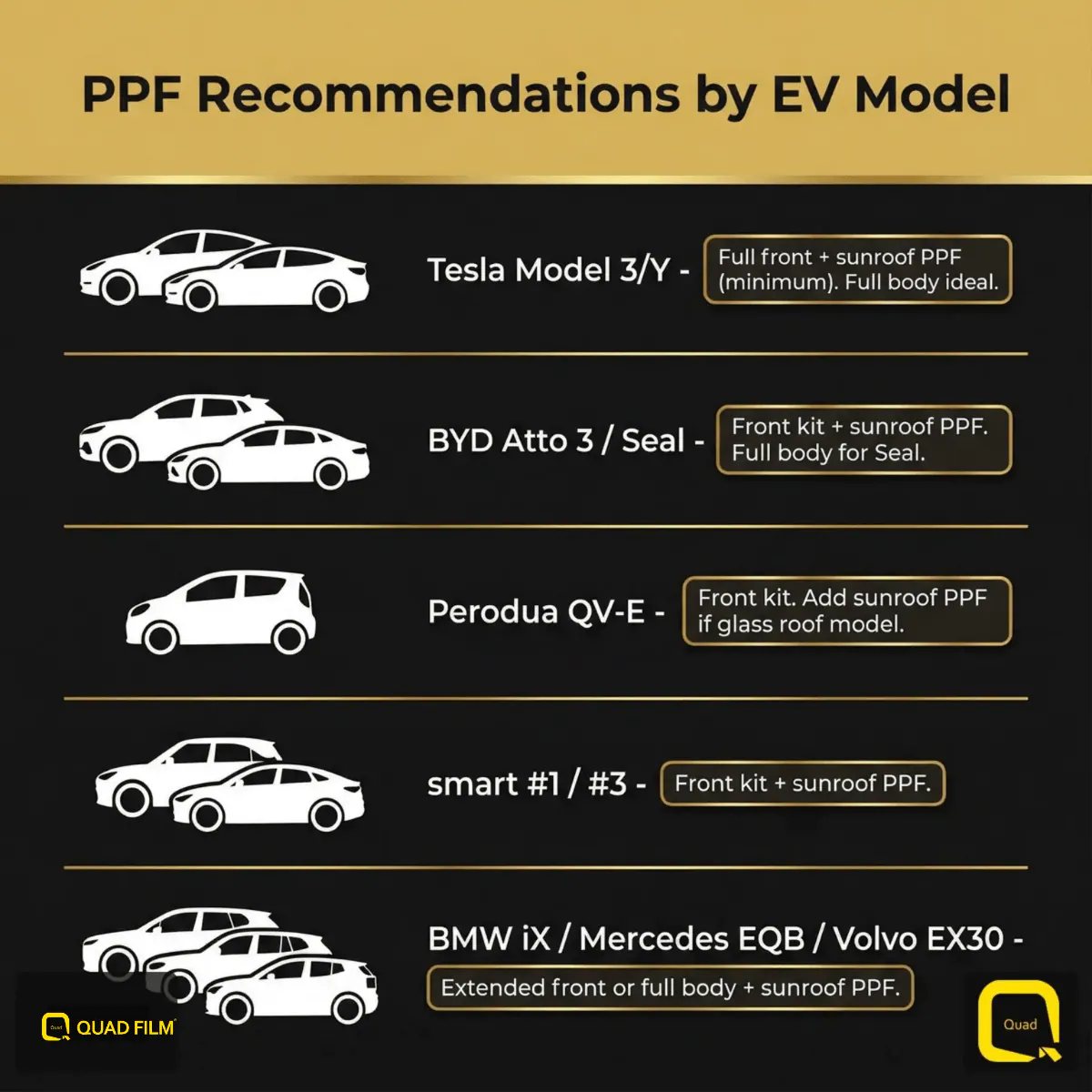
Here is a quick reference for the most common EVs on Malaysian roads:
- Tesla Model 3 / Model Y -- Full front kit at minimum. Tesla's thin water-based paint is highly prone to stone chips. Full body coverage is the ideal choice. Sunroof PPF is strongly recommended given the full glass roof design.
- BYD Atto 3 / Seal / Dolphin -- Front kit plus sunroof PPF covers the most common damage areas. For Seal owners with a higher vehicle value, full body is worth considering.
- Perodua QV-E -- A front kit is a smart starting point for this more budget-friendly EV. Add sunroof PPF if your model has a glass roof.
- smart #1 / #3 -- Front kit plus sunroof PPF. These compact city EVs pick up a lot of road debris in KL stop-and-go traffic.
- BMW iX / i4, Mercedes EQA / EQB, Volvo EX30 -- Extended front or full body coverage is recommended given the vehicle value (often RM250,000+). Add sunroof PPF for any panoramic roof model.
Matte and Colour PPF for EVs
Some EV owners go beyond clear PPF and choose matte or colour PPF to change the look of their car while adding full protection at the same time. A white Tesla wrapped in matte PPF gets the popular stealth look without a permanent respray. Colour PPF can transform a factory white BYD Seal into a deep satin tone, and the film is fully removable if you ever want to go back to the original colour.
Matte and colour PPF options carry a 5-year warranty and use the same self-healing TPU base as standard PPF. For more on these options, see our article on matte ppf malaysia.
Protect Your EV Before the First Highway Drive
The best time to apply PPF is within the first few weeks of ownership, before the car picks up stone chips, scratches or parking lot door dings. Many dealers now offer PPF as a delivery add-on, but it is worth comparing with specialist installers who may use better film grades and have more experience with EV-specific panel work.
Before your EV's first highway drive, get the front end protected at minimum. If you have a panoramic glass roof and park outdoors regularly, add sunroof PPF to the package. Your cabin temperature and your paint will both benefit.
Quad Film PPF for Electric Vehicles
Quad Film offers a full range of PPF options designed for electric vehicles. The lineup includes:
- Body PPF -- QUANTUM (10 MIL, 99% self-healing, 7-year warranty), QUATTRO (8.5 MIL, 7-year warranty) and QUANTA (7.5 MIL, 5-year warranty) for gloss coverage. QUBOND (7.5 MIL, 5-year warranty) for matte finish, and QUATRIX (7.5 MIL, 5-year warranty) for satin / semi matte finish. All use a double-layer TPU structure with Ashland adhesive.
- EV Sunroof PPF -- 7 MIL film with 24 layers of rare earth metals via magnetron sputtering. Over 95% heat reflection, more than 99% UV block, 72% VLT. Proven 10% power saving in real-world battery testing.
- Titanium Sunroof PPF -- Higher-tier sunroof PPF option with advanced heat rejection performance, starting from RM800.
- Hybrid Packages -- Full front and bumper PPF combined with Gtechniq Crystal Serum Light Coating for owners who want impact protection on the front and a coated finish on the rest of the car.
Quad Film authorized outlets in the Klang Valley regularly install on Tesla, BYD, smart and other popular EV models. Book a consultation to get a protection package matched to your specific car.
FAQs
Does PPF affect my EV's autopilot cameras or parking sensors?
No. Quality clear PPF is optically transparent and does not block radar, ultrasonic or camera signals. The key is to work with an installer experienced in EV-specific sensor placements. Camera lenses and radar housings are typically left uncovered or handled with precision cuts.
Will sunroof PPF make my panoramic roof look different from inside the cabin?
The film has a VLT (visible light transmittance) of 72%, which means you retain most of the natural light and visibility through the glass. From inside, the roof still looks clear with a very slight tint. From outside, there is minimal visual change.
Is PPF worth it for a more affordable EV like the Perodua QV-E or BYD Dolphin?
Yes, even on a lower-priced EV, the front bumper and bonnet are exposed to the same highway debris as any other car. A partial front kit is a cost-effective way to protect the highest-risk panels. Budget from RM3,600 for a front and bumper hybrid package with ceramic coating on the rest of the body.
How much cooler will my EV cabin be with sunroof PPF installed?
In controlled testing, interior temperature dropped from 52 degrees to 22 degrees after applying EV Sunroof PPF. Real-world results vary based on ambient temperature, parking duration and glass type, but most owners report a noticeable difference within the first week of use.
Can I apply PPF to my Tesla's glass roof without voiding the warranty?
PPF is an external protective film applied to the surface of the glass. It does not alter the glass structure or any integrated electronics. Applying PPF to the roof glass does not void the vehicle warranty. If you ever need to remove the film, it comes off cleanly with no residue.
Protect your Investment today
Don't wait for stone chips to ruin your paint. Speak to our experts about custom PPF and Tinting solutions.