
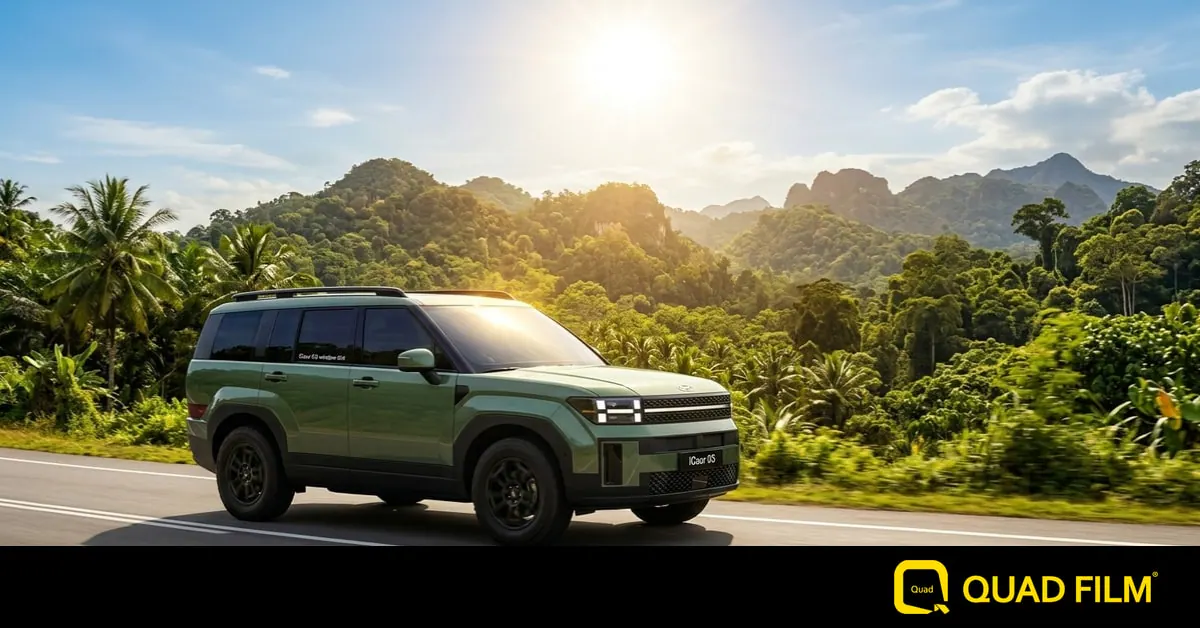
- The iCaur 03 pairs a large panoramic roof, a glare-prone 15.6 inch screen, and camera-based ADAS, so the right tint has to cool, stay clear, and stay signal-safe.
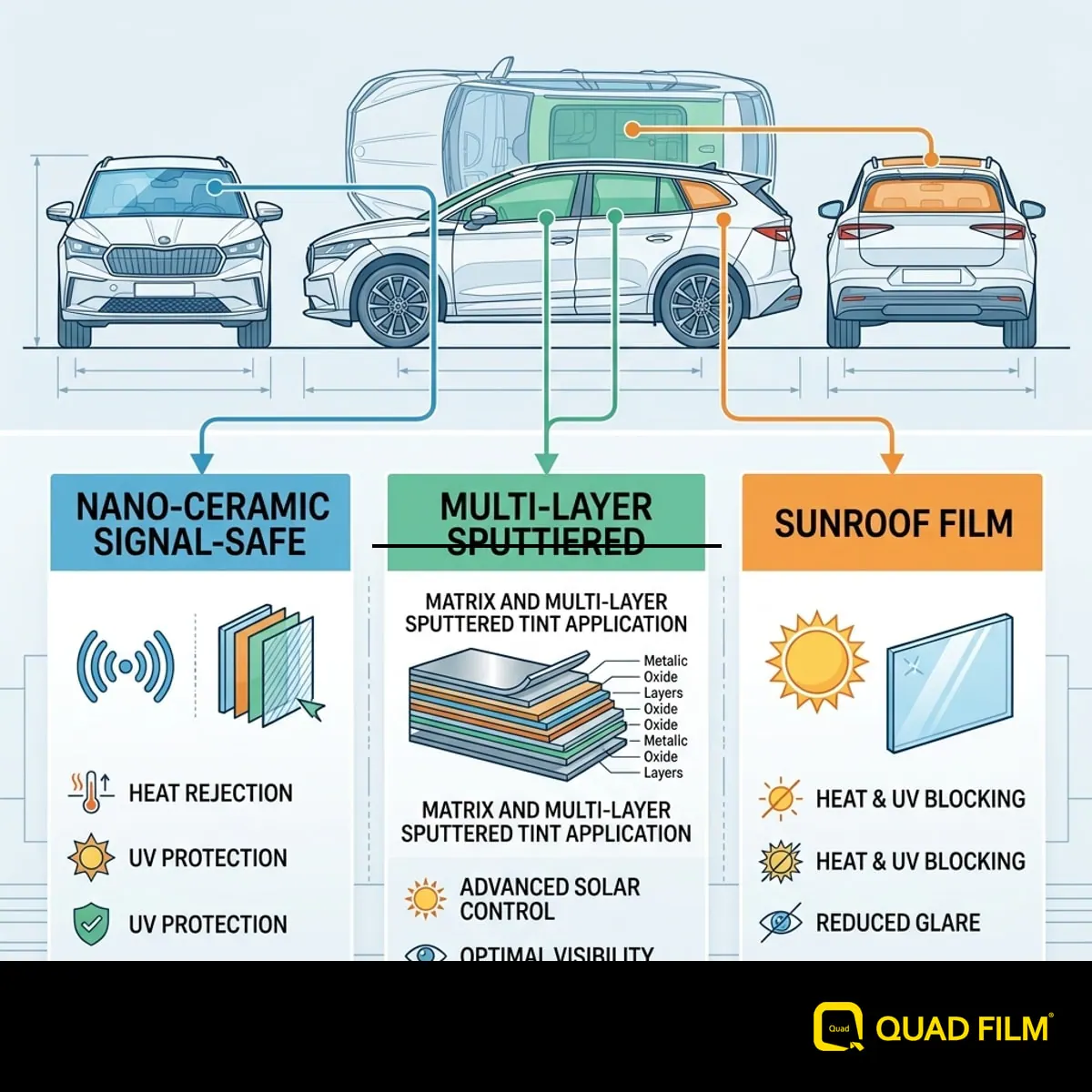
- Put signal-friendly nano-ceramic film on the windscreen to protect the cameras and toll tag, and multi-layer sputtered film on the cabin glass for long-life heat rejection.
- A dedicated sunroof film handles the glass roof, the single biggest heat source, without blacking out the open feel.
- Lower cabin heat eases the A/C load on the LFP battery, which a controlled Quad Film test linked to about a 10 percent power saving.
The right iCaur 03 window tint in Malaysia has to do three jobs at once, cool a large panoramic sunroof, keep the ADAS cameras and toll tag working, and ease the air conditioning load that drains an EV battery on a hot day. The iCaur 03 launched as a CKD model from Shah Alam on 20 May 2026 at RM119,800 for the 2WD and RM129,880 for the iWD, and its glass-heavy, camera-rich design makes the tint choice more important than on an ordinary SUV. This guide explains the heat and range problem, answers the camera question honestly, and lays out the two-tier film setup that suits the car.
What the iCaur 03 Glass Stack Means for Heat and Range
The iCaur 03 carries a panoramic sunroof with a powered sunshade, a 15.6 inch touchscreen, ADAS Level 2.0 with forward and 540-degree cameras, and an LFP battery of 65.7 or 69.8 kWh rated at 418 to 426 km NEDC. That combination defines the tint brief. Large glass means a large heat load, camera-based driver assistance means the windscreen film must stay clear and signal-safe, and a range-sensitive LFP battery means every watt the air conditioning saves shows up as usable kilometres. Treat the car as a glass stack to be managed pane by pane, not a single tint job.
Malaysian conditions make that pane-by-pane approach matter even more. The car spends its days under a UV index that regularly reaches 11 to 13 and afternoon heat above 35 degrees, often in open-air mall parking with the panoramic roof facing straight up at the sun.
The glass stack breaks down into three jobs:
- The panoramic roof: The single largest heat gateway, lying flat to the sky and taking the full overhead sun.
- The side and rear cabin glass: The widest area of vertical glass, where sustained heat rejection over many years matters most.
- The windscreen: The pane that must stay clear and signal-safe because the ADAS and forward camera sit behind it.
The Panoramic Sunroof Heat Problem
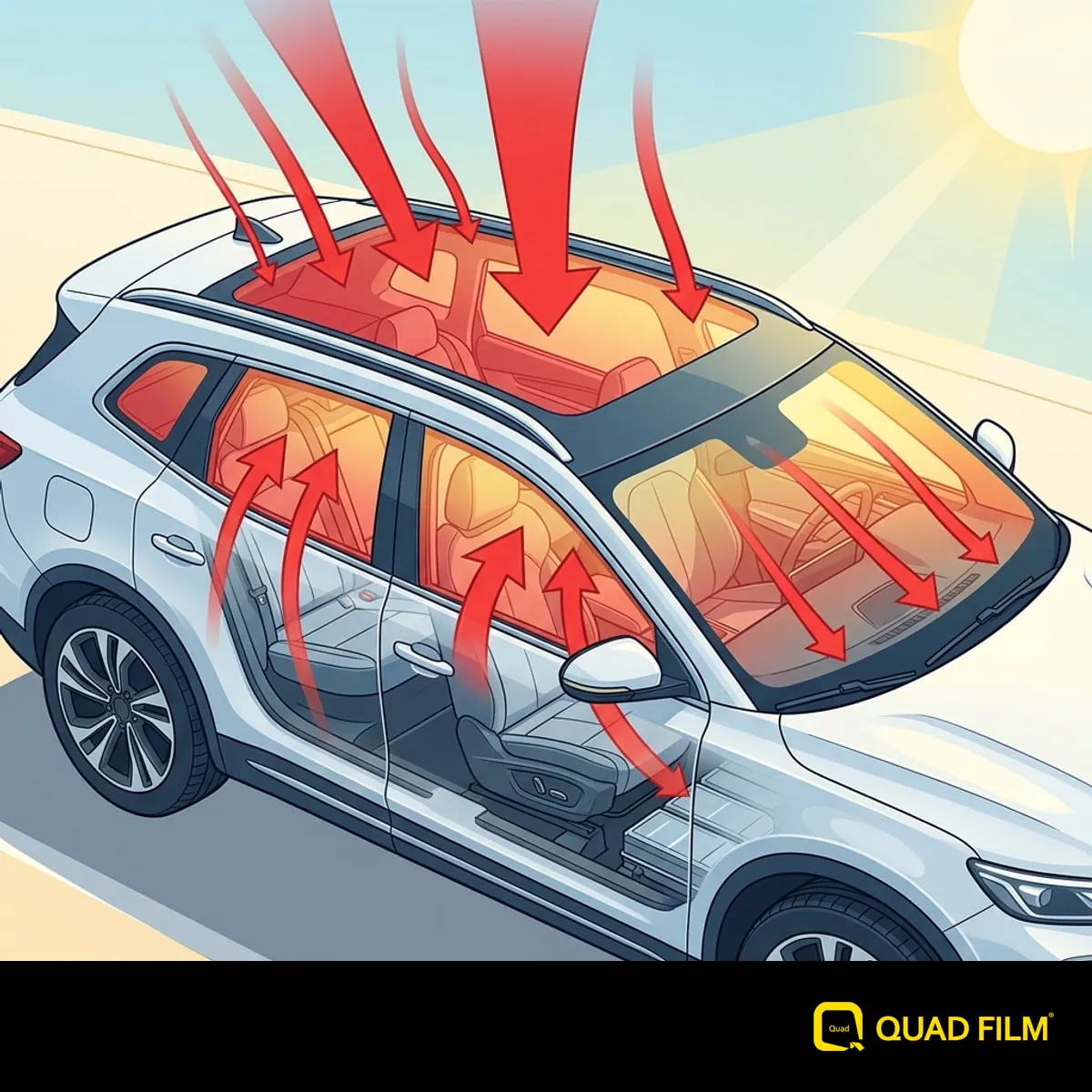
The panoramic roof is the headline feature and the biggest heat gateway. It lies flat to the sky and takes the full overhead sun, so it loads the cabin faster than any side window. There are three ways to manage it, and they work best together.
Tint, sunroof film, or the factory sunshade
The factory powered sunshade blocks light but does little for radiant heat, since the glass still bakes above it. A heat-rejecting sunroof film treats the heat at the glass itself. Quad Film EV Sunroof PPF, also called Titanium Sunroof PPF, uses 24 layers of rare earth metals, reflects more than 95 percent of heat, blocks more than 99 percent of ultraviolet, keeps a 72 percent visible light level so the roof still feels open, and carries a 5-year warranty. In Quad Film testing it cut interior temperature from 52 to 22 degrees. Roof film and the sunshade together give you both shade and genuine heat control. JPJ rules do not restrict the roof, so you have a free hand there.
The three roof options line up like this:
- Factory powered sunshade: Blocks visible light and glare, but the glass above it still heats up, so it does little for radiant heat on its own.
- Heat-rejecting sunroof film: Treats heat at the glass. The Quad Film EV Sunroof PPF rejects more than 95 percent of heat and blocks more than 99 percent of ultraviolet while keeping a 72 percent visible light level, priced by roof size from RM800 Standard to RM1,200 Large and RM1,800 X-Large.
- Both together: The sunshade for on-demand shade and the film for constant heat control, the combination most owners settle on.
Will Tint Interfere With ADAS and the 540-Degree Cameras?
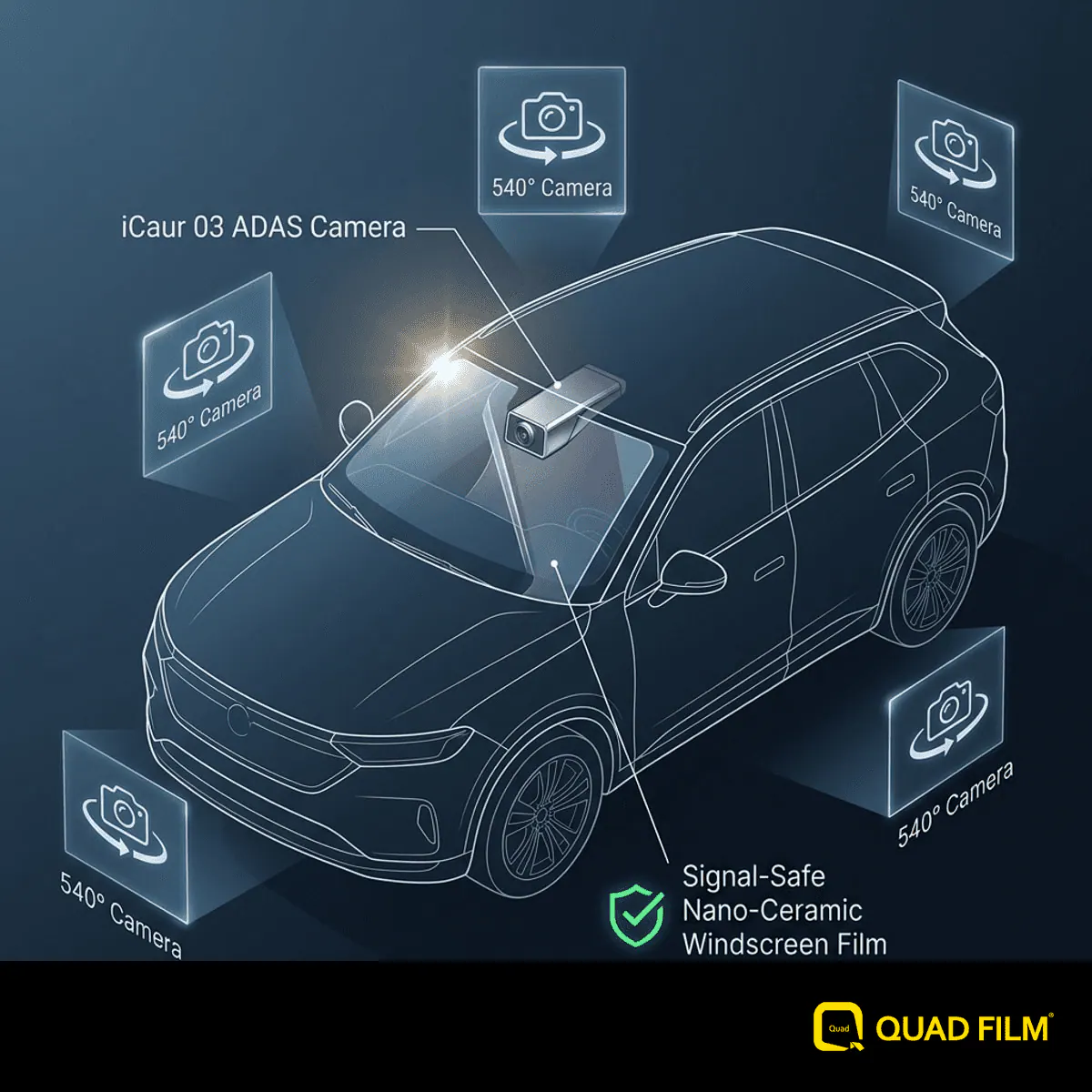
This is the question iCaur 03 owners ask most, and the honest answer is that it depends on the film. The 540-degree camera system and the forward ADAS camera are optical, so a high-clarity film does not block them. The real risk is radio interference from conductive metal film placed over the windscreen camera area.
Why MATRIX on the windscreen is signal-safe
Quad Film MATRIX is a nano-ceramic film built from titanium nitride and zirconium oxide at 2 mil, with a 5-year warranty and a TSER of 60 to 73 percent. It is non-conductive and documented as SmartTag and RFID friendly, so it keeps the cameras, toll tag, and keyless entry working. For the windscreen, where the cameras sit, MATRIX is the safe choice. Note too that Touch n Go SmartTAG runs on infrared and is not affected by window film at all.
In practice, a clean iCaur 03 install comes down to a few points:
- Non-conductive film on the windscreen: MATRIX nano-ceramic carries no metal layer to interfere with the forward camera or the toll tag.
- High clarity for the cameras: A clear windscreen film keeps the forward ADAS view and the 540-degree camera feed sharp, day and night.
- A tidy cut around housings: A skilled installer trims neatly around the camera and sensor housings rather than covering them.
- SmartTAG stays unaffected: Because the toll tag is infrared based, no window film blocks it.
EV Range: How Tint Reduces A/C Load
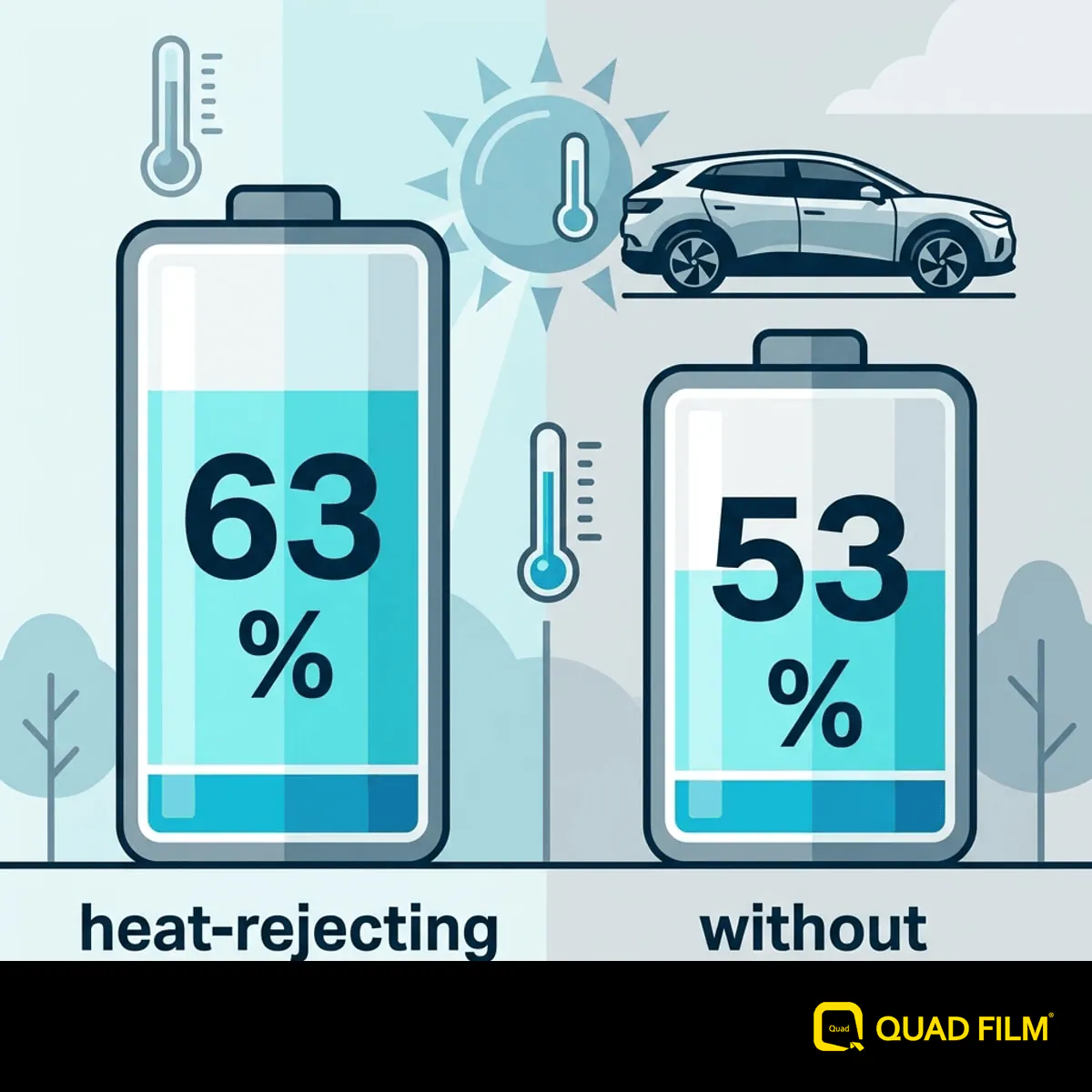
On an electric car the air conditioning is one of the largest loads after the motor, so cabin heat is really a range question. The chain is simple. A higher TSER film rejects more solar energy, the cabin starts and stays cooler, the air conditioning works less, and the battery holds more charge. In a controlled Quad Film comparison, a vehicle protected with the sunroof film ended at 63 percent battery against 53 percent for an unprotected reference after 140 km, run at 33 to 35 degrees ambient with the air conditioning set to 20 degrees, which points to roughly a 10 percent efficiency saving. On the iCaur 03 LFP battery rated at 418 to 426 km NEDC, that is a meaningful estimate rather than a fixed promise, since real range depends on how you drive.
There is a second saving owners often miss. Pre-cooling a parked iCaur 03 on a 35 degree afternoon pulls hard on the LFP battery, and a cabin that started cooler under high-TSER film needs less of that energy before you drive off. Across a week of open-air parking and short trips, the lower air conditioning load is where the steadier range really shows, most of all on the hottest days.
The MATRIX and MLS Two-Tier Setup Explained
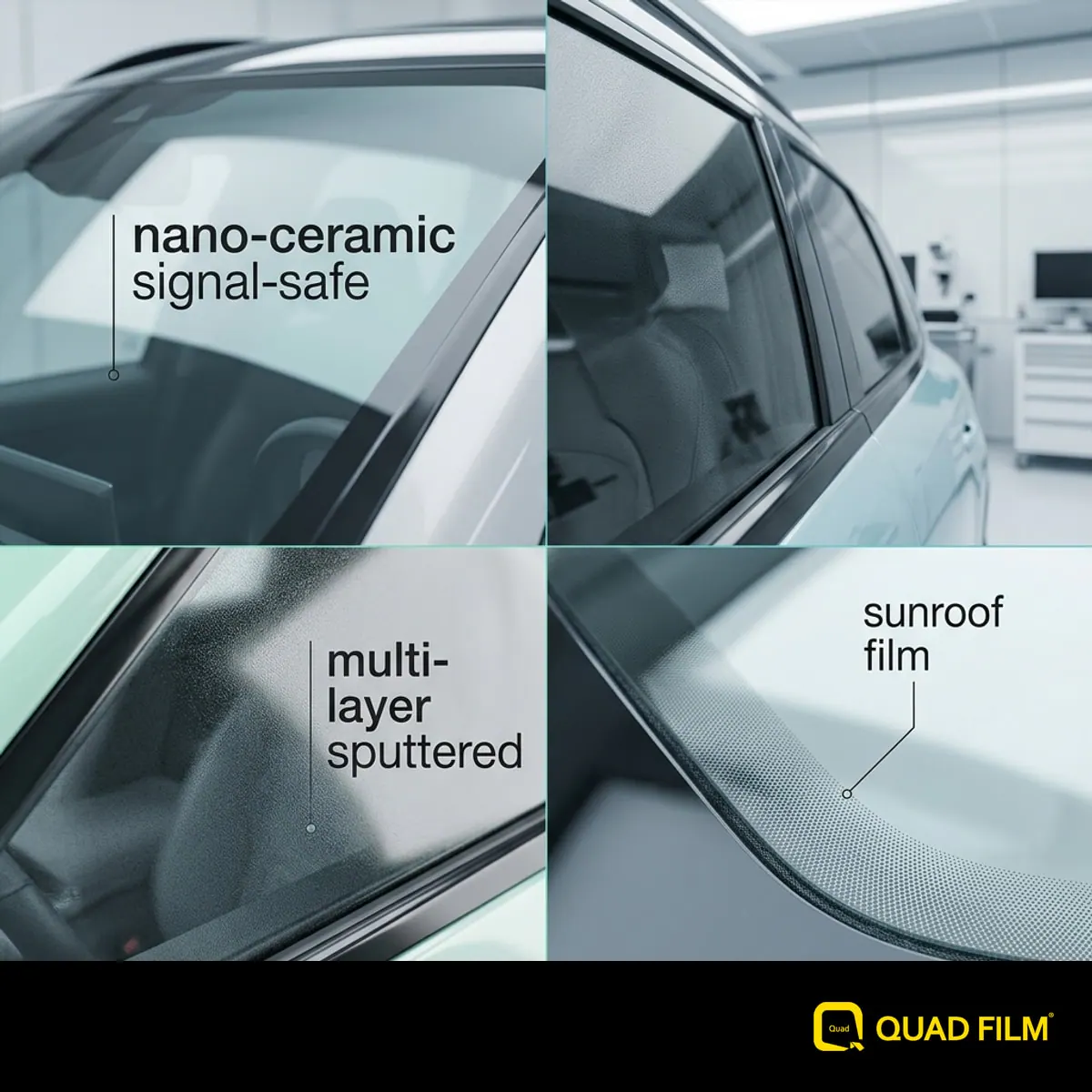
The setup that suits the iCaur 03 splits the glass into two jobs. The windscreen gets MATRIX nano-ceramic film for clarity and signal safety where the cameras live. The side and rear cabin glass gets multi-layer sputtered film for the strongest sustained heat rejection and the longest life. The panoramic roof gets the dedicated sunroof film. Quad Film multi-layer sputtered options for the cabin include MEGALUX, a 48-layer film at 4 mil with a 15-year warranty and a TSER of 72 to 85 percent, METALUX, a 24-layer film at 4 mil with a 10-year warranty and a TSER of 70 to 83 percent, MAGNETRON, a 12-layer film with an 8-year warranty and a TSER of 66 to 79 percent, and MIRACLE, a film with a 7-year warranty and 100 percent UV blocking. All the sputtered films use 36 rare earth metals built in a German Leybold dual-vacuum chamber.
Here is how the two-tier setup maps to the glass.
| Glass zone | Recommended Quad film | Key figure | Warranty |
|---|---|---|---|
| Windscreen | MATRIX nano-ceramic | TSER 60 to 73 percent, signal-safe | 5 years |
| Side and rear glass | MEGALUX 48-layer or METALUX 24-layer | TSER 72 to 85 or 70 to 83 percent | 15 or 10 years |
| Panoramic roof | EV Sunroof PPF | Heat reflection above 95 percent, VLT 72 percent | 5 years |
Why Multi-Layer Sputtered Beats Single-Layer Ceramic on Longevity
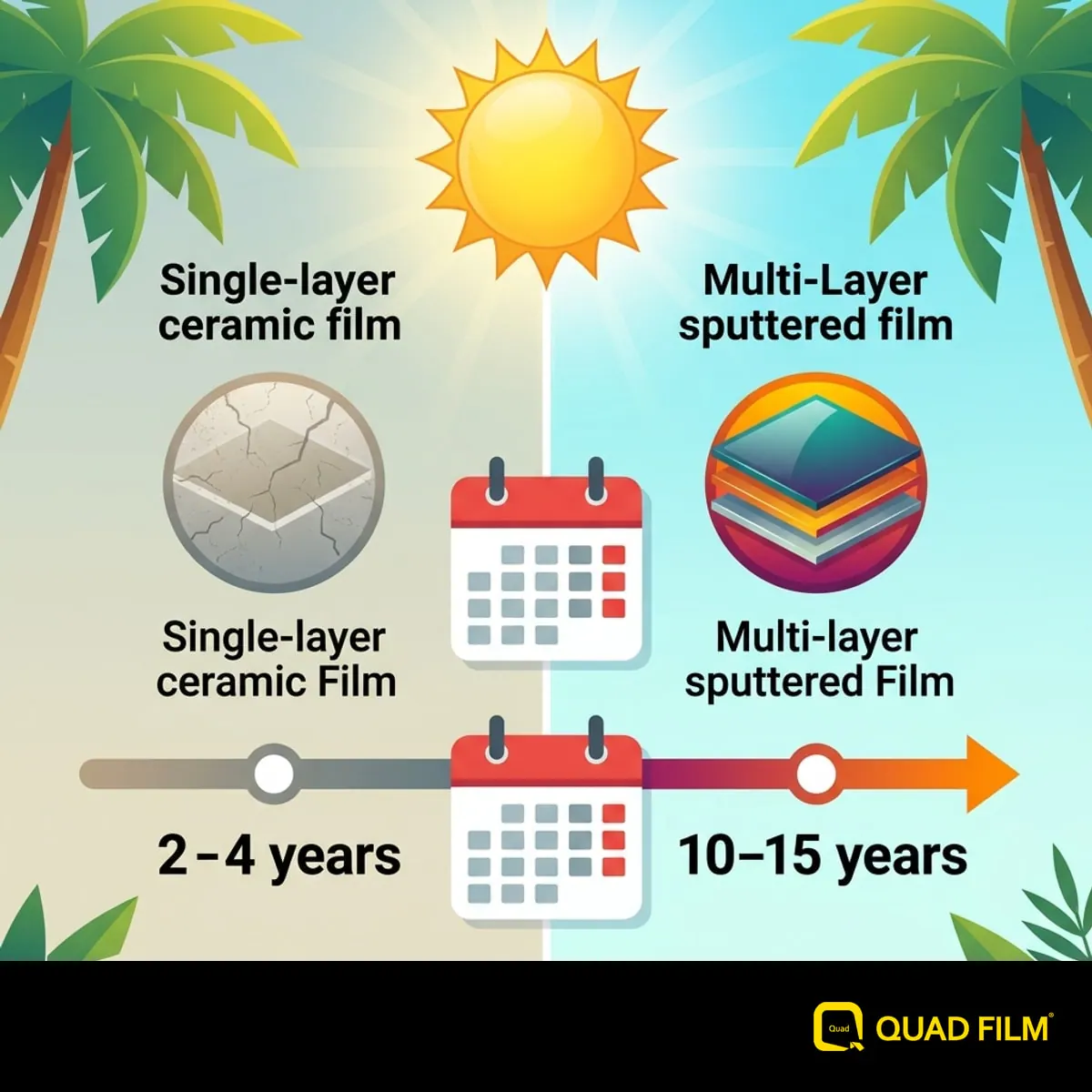
Many shops push a single-layer ceramic film as a one-size answer, but in tropical heat longevity is where it falls short. A single-layer film can oxidise and lose performance within two to four years, while a multi-layer sputtered film holds its heat rejection far longer, backed by 10 to 15 year warranties on the top Quad Film series. For the cabin glass, where the film must survive years of sun without fading, the multi-layer sputtered build is the stronger long-term value. MATRIX still earns its place on the windscreen for signal safety, which is why the two-tier setup uses each film where it is strongest.
The longevity gap comes down to how the films are built:
- Layer count: Quad multi-layer sputtered films stack many metal layers, from the 12-layer MAGNETRON up to the 48-layer MEGALUX, so performance is spread across a deep structure rather than one thin coat.
- Construction: The sputtered series use 36 rare earth metals built in a German Leybold dual-vacuum chamber, which resists the oxidising that fades cheaper film.
- Warranty backing: MEGALUX is warranted for 15 years and METALUX for 10, against the 2 to 4 year window where single-layer ceramic can start to drop off.
JPJ VLT Limits for the iCaur 03
The law sets a clear floor. The windscreen must allow at least 70 percent of visible light through, the front side windows at least 50 percent, and the rear windows have no limit. A reputable installer measures the glass, keeps the front legal, and applies darker, high-rejection film to the rear and the roof where the rules allow it.
The limits in short:
- Windscreen: At least 70 percent visible light through, which is why a high-clarity film like MATRIX suits it.
- Front side windows: At least 50 percent visible light through.
- Rear side and tailgate glass: No legal limit, so you can run a darker, higher-rejection sputtered film here.
- Panoramic roof: Not restricted by JPJ, so the sunroof film is a free choice.
Packages and Pricing
Quad Film full car tint pricing in the Standard range runs from about RM1,000 for MATRIX, RM2,200 for MAGNETRON, RM3,200 for METALUX, and RM4,600 for MEGALUX, so there is a clean step up at each budget. The EV Sunroof PPF for the glass roof is priced by size at RM800 for Standard, RM1,200 for Large, and RM1,800 for X-Large. A typical iCaur 03 owner pairs a sputtered cabin film with MATRIX on the windscreen and adds the sunroof film for the roof.
The Standard full car tint prices line up as a clean step at each budget.
| Film | Type | TSER | Warranty | Full car from |
|---|---|---|---|---|
| MATRIX | Nano-ceramic, signal-safe | 60 to 73 percent | 5 years | RM1,000 |
| MAGNETRON | 12-layer sputtered | 66 to 79 percent | 8 years | RM2,200 |
| METALUX | 24-layer sputtered | 70 to 83 percent | 10 years | RM3,200 |
| MEGALUX | 48-layer sputtered | 72 to 85 percent | 15 years | RM4,600 |
The EV Sunroof PPF for the glass roof is priced separately by size at RM800 Standard, RM1,200 Large, and RM1,800 X-Large.
How to Choose Your Setup
Match each film to the glass and to how you drive. If you want the longest life and the best sustained heat rejection for daily sun parking, choose a higher sputtered grade for the cabin. Keep MATRIX on the windscreen for camera and signal safety, and add the sunroof film to tame the panoramic roof. Ask a verified installer to measure your glass and quote the two-tier setup with the roof film. You can compare the range on the Quad Film window tint page and book through the installer directory.
What to Check Before You Tint
A good setup is only as good as the film and the fit, so a short checklist protects your spend.
- Named film and warranty: A trustworthy installer states the exact series going on each pane, whether MATRIX, MAGNETRON, METALUX, or MEGALUX, with its TSER and warranty in writing.
- Signal-safe windscreen: Confirm the windscreen film is non-conductive nano-ceramic so the cameras and toll tag stay clear, not a metal film over the camera area.
- Measured VLT: A reputable shop measures the glass and keeps the windscreen at 70 percent and front sides at 50 percent to stay legal.
- Clean install space: A dust-free bay matters, since trapped specks and edge lift show on large panes like the roof and tailgate.
Is the Two-Tier Setup Worth It on the iCaur 03
For a glass-heavy EV that lives in Malaysian heat, the two-tier setup earns its place. MATRIX keeps the windscreen clear and signal-safe for the cameras, multi-layer sputtered film gives the cabin long-life heat rejection led by TSER, and the sunroof film tames the single biggest heat source. The result is a cooler cabin, a lighter air conditioning load on the LFP battery, and driver assistance that keeps working. If budget is tight, start with the roof film and a sputtered cabin film, then add MATRIX on the windscreen.
Closing
The iCaur 03 is a glass-heavy EV that rewards a considered tint plan. Cool the panoramic roof, keep the windscreen clear and signal-safe for the cameras, and choose long-life film for the cabin, and you get a cooler car, steadier range, and driver assistance that keeps working. For more, start with our complete car tint guide, then read why metal film wins for EVs, how sputtered and multi-layer sputtered film differ, how nano-ceramic compares to sputtered film, the truth about tint and GPS or SmartTag signals, and the difference between factory and aftermarket tint.
Frequently Asked Questions
Will tint block the iCaur 03's 540-degree camera or ADAS?
No. The cameras are optical, so a high-clarity film does not block them. Use a non-conductive nano-ceramic film like MATRIX on the windscreen to avoid radio interference around the forward camera and toll tag.
How much EV range can window tint actually save?
It is an indirect gain through lower air conditioning load. A controlled Quad Film test pointed to about a 10 percent power saving, which is an estimate that varies with conditions and driving style.
Is darker sunroof tint better for heat?
Not necessarily. Heat control comes from the film technology and its heat reflection, not from how dark it looks. The EV Sunroof PPF keeps a 72 percent light level while reflecting more than 95 percent of heat.
What tint VLT is legal in Malaysia?
The windscreen must allow at least 70 percent visible light, the front side windows at least 50 percent, and the rear glass has no legal limit.
Does ceramic tint last as long as sputtered film?
Single-layer ceramic can oxidise within two to four years, while multi-layer sputtered film is warranted for 10 to 15 years on the top series. That is why the cabin glass suits sputtered film and the windscreen suits signal-safe nano-ceramic.
Should I tint the panoramic roof or only the side windows?
Treat the roof as the priority, since it lies flat to the sky and loads the cabin with heat faster than any side window. A dedicated sunroof film with heat reflection above 95 percent and a 72 percent light level cools the roof while keeping the open feel, then the side and rear glass add cabin heat rejection.
Why compare iCaur 03 tint on TSER instead of IRR?
TSER, or total solar energy rejected, measures the full solar load a film keeps out, while infrared rejection covers only part of the spectrum. Leading with TSER gives a truer sense of how cool the cabin will feel. The Quad sputtered films run a TSER of 70 to 85 percent on the top series.
How long does multi-layer sputtered tint last in Malaysia?
The top Quad sputtered films are warranted for 10 to 15 years, with MEGALUX at 15 and METALUX at 10. Built from 36 rare earth metals in a German Leybold dual-vacuum chamber, they resist the oxidising that fades single-layer ceramic in two to four years.
Protect your Investment today
Don't wait for stone chips to ruin your paint. Speak to our experts about custom PPF and Tinting solutions.